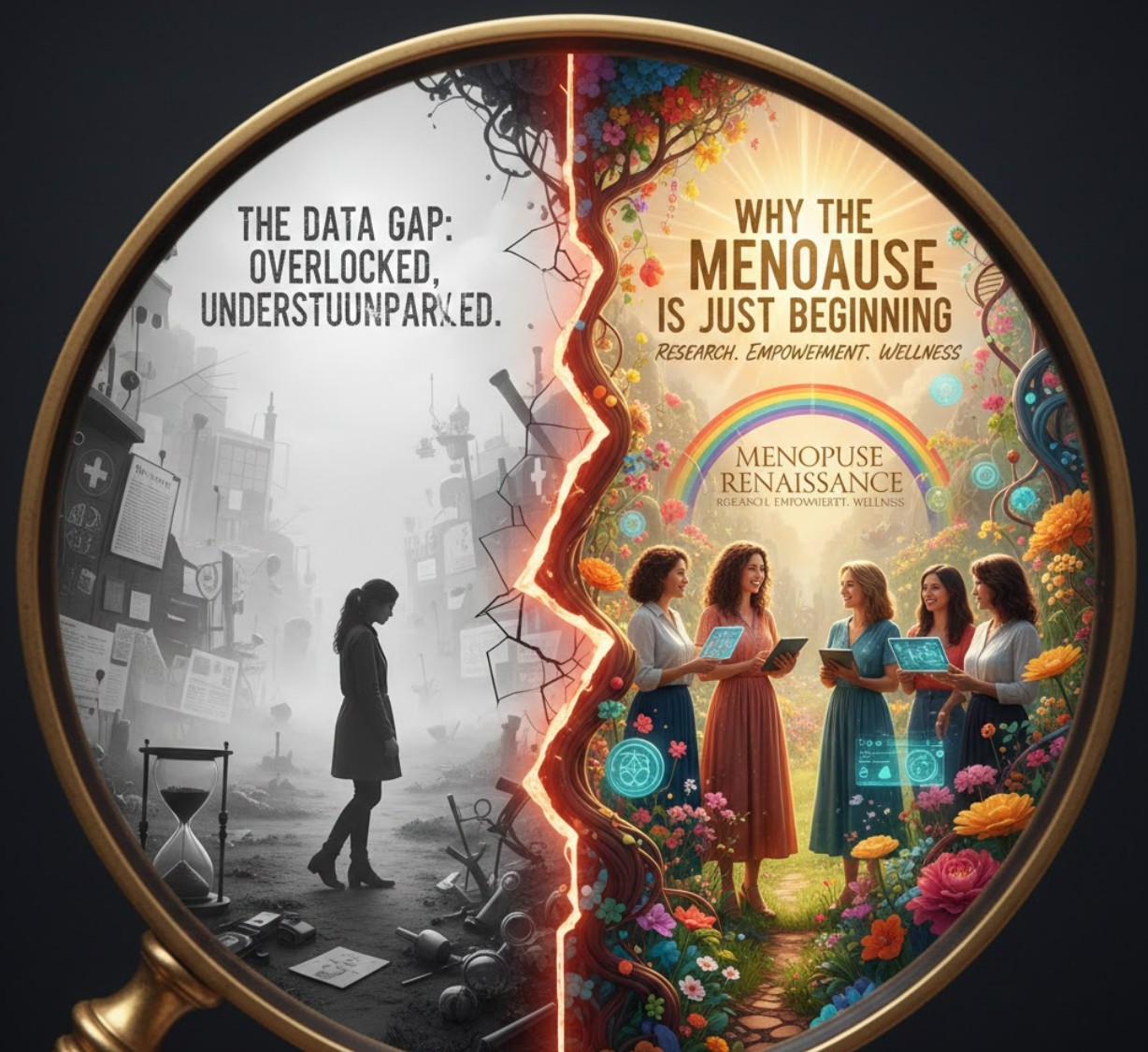
The Silent Pause: How the Data Gap Failed Women and Why the Menopause Renaissance is Just Beginning
Introduction: The Paradox of the “Niche”
For decades, the medical establishment treated women’s health as a niche specialty—a subset of medicine usually restricted to the uterus and the breasts. This perspective, often disparagingly called “bikini medicine,” ignored a fundamental biological reality: women are not merely smaller men with reproductive organs. They are physiologically distinct in every system of the body, from cardiovascular function to drug metabolism.
Nowhere has this oversight been more glaring, or more damaging, than in the treatment of menopause. It is a biological transition that 50% of the global population will experience if they live long enough. Yet, for generations, it was shrouded in silence, dismissed as a hysterical phase, or treated with a “grin and bear it” attitude by a medical community ill-equipped to manage it.
Today, however, we are witnessing a seismic shift—a “Menopause Renaissance.” Driven by a convergence of economic necessity, femtech innovation, and a vocal generation of women refusing to suffer in silence, menopause is finally stepping into the light. But to understand where we are going, we must first understand the deep historical void from which we are emerging: the gender data gap.
The Male Default: A History of Exclusion
The roots of the crisis in women’s health lie in a systemic failure to collect data on female bodies. For much of modern medical history, the “70kg white male” was considered the universal anatomical standard.
This exclusion was not just a cultural oversight; it was codified policy. In 1977, following the Thalidomide tragedy—where a sedative prescribed to pregnant women caused severe birth defects—the US Food and Drug Administration (FDA) issued a ban excluding women of “childbearing potential” from early-phase clinical trials. While the intention was protection, the result was a catastrophe of ignorance. For nearly two decades (until the ban was lifted in 1993), drugs and treatments were tested almost exclusively on men, yet prescribed to women.
The consequences of this data gap are lethal and lingering. Women are more likely to experience adverse drug reactions because dosages are historically calibrated for male metabolisms. Heart disease remains the leading cause of death for women, yet they are frequently misdiagnosed because their symptoms (nausea, fatigue, jaw pain) differ from the “Hollywood heart attack” (crushing chest pain) typical in men.
When this “male-as-default” lens was applied to menopause—a condition men do not experience—the result was not just bad data, but no data. Menopause was viewed not as a complex endocrine event affecting the brain, bones, and heart, but as a mysterious “failure” of femininity.
The Menopause Void: “Just Go Home and Relax”
If you ask a room of menopausal women about their experiences with doctors, the stories are remarkably consistent. They speak of being offered antidepressants for hot flashes, being told their brain fog is “just aging,” or being dismissed entirely.
This gaslighting is rarely malicious; it is structural. A survey of US obstetrics and gynecology residents found that fewer than 20% received formal training in menopause medicine. In the UK, until recently, 41% of medical schools did not have a mandatory menopause curriculum. We have been sending doctors into the world without the map to navigate one of the most significant health events in a woman’s life.
The lack of research has also stalled treatment innovation. For twenty years, following the misinterpretation of the Women’s Health Initiative (WHI) study in 2002, Hormone Replacement Therapy (HRT)—the gold standard for symptom management—was demonized. A generation of women was denied relief based on fear-mongering headlines rather than nuanced science, leaving millions to navigate insomnia, anxiety, joint pain, and genitourinary syndrome without support.
The Economic Wake-Up Call
What finally forced the world to pay attention wasn’t just altruism; it was economics. The demographic of women going through menopause—typically aged 45 to 55—is no longer staying home. They are the fastest-growing demographic in the workforce.
These women are often at the peak of their careers: holding board seats, running companies, and managing teams. When debilitating symptoms strike without medical support, the economic fallout is massive. Studies estimate that global productivity losses due to menopause could top $150 billion annually. In the UK alone, one in ten women has left her job due to menopausal symptoms.
Corporations and governments have realized they are facing a “brain drain” of senior female talent. This realization has sparked a wave of workplace menopause policies, from temperature-controlled offices to flexible leave, transforming menopause from a private shame into a public economic priority.
The Renaissance: Femtech and the $600 Billion Opportunity
Into this vacuum of care has stepped the booming “Femtech” industry. Venture capital, once hesitant to touch “women’s issues,” is now chasing a market estimated to be worth over $600 billion by 2027.
We are seeing a revolution in innovation. There are now wearable devices that use thermal pulses to disrupt hot flashes, apps that track symptoms to generate data for doctors, and telemedicine platforms dedicated entirely to midlife women’s health. “Menopause” is no longer a dirty word; it is a buzzword.
Celebrities like Michelle Obama, Naomi Watts, and Gwyneth Paltrow have leveraged their platforms to normalize the conversation, stripping away the stigma. The “change of life” is being rebranded as a “second spring”—a time of empowerment rather than decline.
Navigating the Hype: The Risk of “Menowashing”
However, the Renaissance brings its own risks. The sudden profitability of menopause has led to “menowashing”—the marketing of expensive, scientifically dubious supplements and creams to vulnerable women. A “menopause-friendly” chocolate bar or a $100 face cream is not a substitute for evidence-based medical care.
True equity requires more than consumer products. It requires closing the research gap. We need robust, sex-specific studies on how the drop in estrogen affects the cardiovascular system, the brain’s gray matter, and immune function. We need the National Institutes of Health (NIH) and global bodies to prioritize funding for midlife women’s health, ensuring that the next generation of treatments is rooted in data, not marketing.
Conclusion: From Invisible to Invincible
The Menopause Renaissance is more than a trend; it is a correction of a historical wrong. We are moving from an era where women were treated as “little men” to an era where female biology is studied, respected, and treated on its own terms.
The data gap is slowly closing, filled by the voices of women who are tracking their own data, demanding better answers, and refusing to step back. The transition may be biological, but the revolution is entirely cultural. By bringing menopause out of the shadows, we are not just improving healthcare; we are rewriting the narrative of aging for half the human race.