Is It Just Stress or High-Functioning Anxiety? 5 Warning Signs You Shouldn’t Ignore
The lifestyle tips and educational content shared in this article are not a substitute for professional mental health diagnosis, therapy, or medical treatment. If you are struggling with your mental health, please reach out to a licensed therapist or healthcare provider.
On paper, you have it all together. You meet your deadlines at work, organize social events, keep your home clean, and always reply to messages. People look at you and see a calm, organized, and highly motivated overachiever.
But inside? Your mind is constantly racing. You wake up with a knot in your stomach, analyze every conversation you had yesterday, and live in constant fear of making a mistake.
If this sounds familiar, you might be dealing with high-functioning anxiety.
Because high-functioning anxiety is not an official medical diagnosis in clinical manuals (like the DSM-5), it often slips under the radar. People who have it rarely seek help because they think, “I’m getting things done, so I must be fine.”
Let’s break down the difference between everyday stress and high-functioning anxiety, and look at the signs you shouldn’t ignore.
Stress vs. Anxiety: What’s the Real Difference?
It is easy to use the words “stressed” and “anxious” interchangeably, but they are not the same.
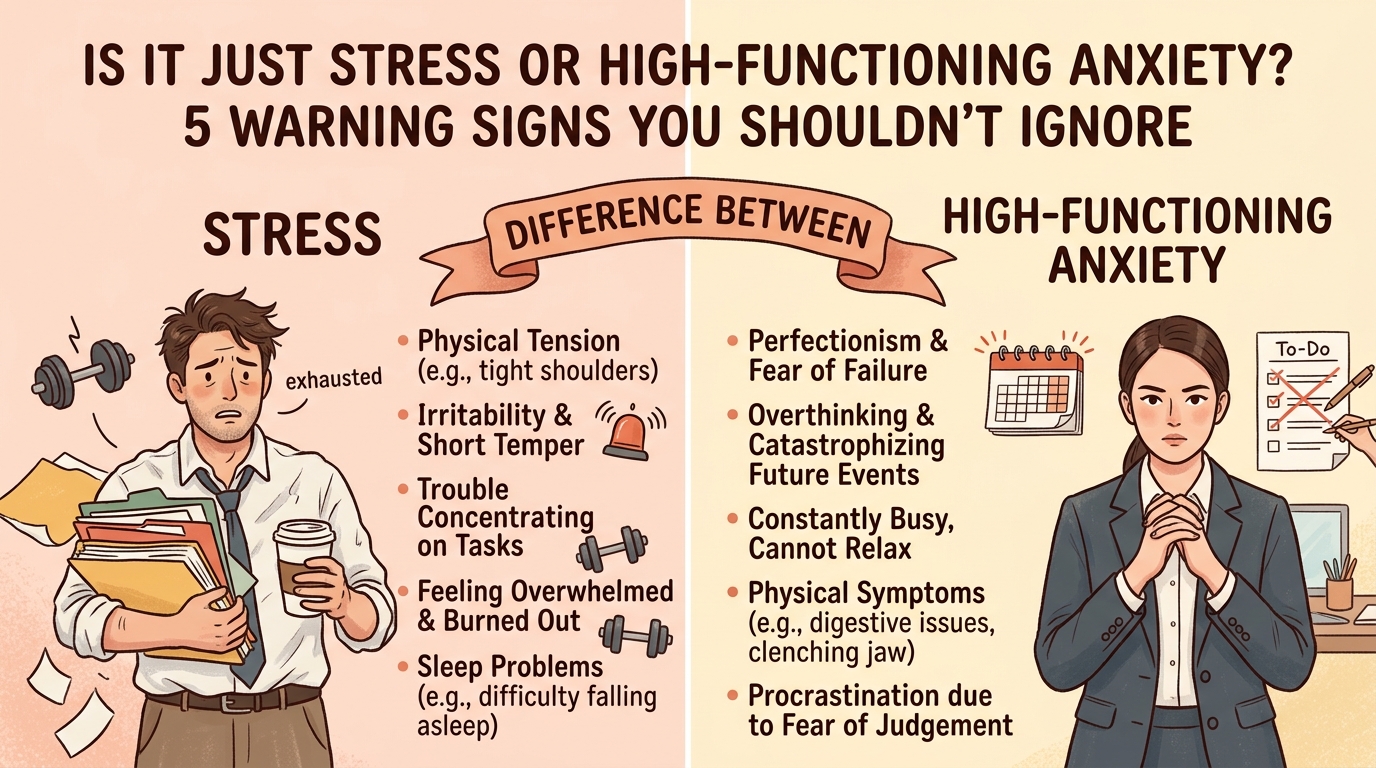
- Stress is a reaction to an external trigger. If you have a massive project deadline, a fight with a partner, or a tight financial month, you feel stressed. Once the situation is resolved or the deadline passes, the stress goes away.
- Anxiety, on the other hand, is an internal response. It is a persistent feeling of apprehension or dread that stays with you even when there is no immediate threat or trigger.
When you have high-functioning anxiety, your anxiety does not paralyze you. Instead, it drives you forward. It acts as an engine fueled by fear, perfectionism, and the dread of failure.
5 Hidden Signs of High-Functioning Anxiety
Because this condition is masked by success, the symptoms look very different from typical anxiety. Here are five warning signs that indicate your drive might actually be anxiety in disguise.
1. You Are Driven by a Deep Fear of Failure (The Perfectionist Mask)
For you, “good enough” does not exist. You double and triple-check your work, spend hours preparing for simple meetings, and obsess over tiny details.
While this makes you look incredibly dedicated to your boss or peers, your motivation isn’t passion—it’s fear. You believe that if you relax for even a moment, everything will fall apart, and people will realize you are “not good enough.”
2. You Have an Inability to Quiet Your Mind (Overthinking)
Do you replay past conversations in your head, wondering if your tone of voice sounded weird? Do you constantly anticipate the worst-case scenarios for future events?
High-functioning anxiety keeps your brain in a perpetual loop of “what-ifs.” This constant mental chatter makes it incredibly difficult to stay present, enjoy your achievements, or focus on a single task without background noise.
3. Sitting Still or Doing “Nothing” Triggers Dread
When you finally have a free weekend or an evening to relax, you feel incredibly uncomfortable. Instead of resting, you feel an urgent need to clean, organize, or start a new project.
People with high-functioning anxiety associate downtime with laziness or wastefulness. Staying busy is actually a coping mechanism used to avoid sitting with uncomfortable, anxious thoughts.
4. You Are a Chronic “People-Pleaser”
Saying “no” feels almost impossible. You take on extra projects at work, say yes to social invitations you don’t have the energy for, and constantly try to accommodate everyone around you.
This behavior stems from a fear of rejection or letting others down. You prioritize other people’s comfort at the expense of your own mental and physical well-being.
5. Your Body is Trying to Tell You Something
Even if you manage to control your facial expressions and keep a calm demeanor, your body holds onto the tension. Common physical signs of high-functioning anxiety include:
- Chronic tension in your neck, shoulders, or jaw (clenching your teeth).
- Trouble falling asleep or staying asleep because your mind won’t shut off.
- Digestive issues, like acid reflux or frequent stomach aches.
- Habitual nervous habits, like nail-biting, skin-picking, or foot-tapping.
Simple Strategies to Manage High-Functioning Anxiety
If you recognized yourself in these signs, please know that you do not have to live in a constant state of silent survival. Here are some small, practical steps you can take to regain balance:
- Practice “Good Enough” Days: Challenge your perfectionism by intentionally leaving a non-essential task incomplete or sending an email without proofreading it three times. Start small to show your brain that minor imperfections do not lead to disaster.
- Ground Yourself with the 5-4-3-2-1 Technique: When your mind starts spinning, use your senses to bring you back to the present. Name:
- 5 things you can see,
- 4 things you can touch,
- 3 things you can hear,
- 2 things you can smell, and
- 1 thing you can taste.
- Set “Unplugged” Boundaries: Set a hard stop-time for work emails and notifications. Give your nervous system a chance to wind down before bed without the pressure of performance.
- Reframe Rest as Recovery: Just like muscles need rest to grow after a workout, your brain needs quiet time to process information. Rest is not a waste of time; it is an essential part of staying healthy.
Frequently Asked Questions (FAQs)
Can high-functioning anxiety turn into panic attacks?
Yes. Because people with high-functioning anxiety tend to suppress their feelings and keep pushing forward, the built-up stress can eventually manifest as sudden physical symptoms, including panic attacks or complete burnout.
How do I talk to my doctor or therapist about this?
Since “high-functioning anxiety” isn’t a formal clinical term, describe your specific internal experiences rather than just your external behavior. For example, explain: “Even though I am performing well at my job, I feel a constant sense of dread, suffer from sleep issues, and feel overwhelmed by overthinking.”
Is medication necessary for high-functioning anxiety?
Not always. Many people successfully manage their symptoms through cognitive behavioral therapy (CBT), talk therapy, lifestyle changes, mindfulness, and stress management techniques. However, for some, a combination of therapy and medication prescribed by a psychiatrist can be highly effective.